
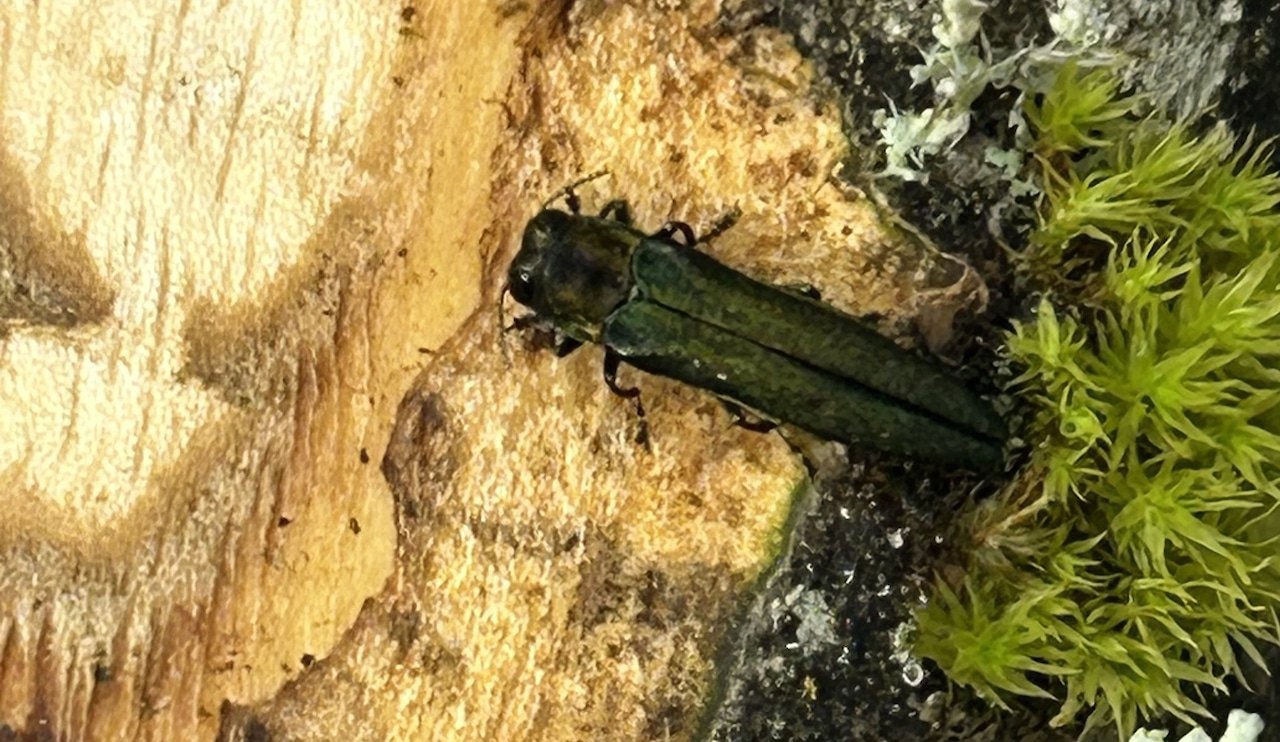
The invasive emerald ash borer has been confirmed in Beaverton, bringing the tree-killing beetle to Washington County's doorstep and threatening ash trees along the Fanno Creek Trail and in yards across Tigard, Tualatin and Durham.
The Oregon Department of Forestry (ODF) announced Thursday, Aug. 6, that traps set in July confirmed the beetle in Beaverton, Salem, Silverton and Rock Creek. An unconfirmed case was also reported at Jackson Bottom Wetlands Preserve in Hillsboro. It marks the first time the pest has been detected in Beaverton, which shares the Fanno Creek corridor with Tigard.
The beetle kills more than 99% of untreated ash trees within two to four years of infestation.
Since arriving in North America in 2002, it has destroyed hundreds of millions of ash trees across 38 states. It was first found on the West Coast in Forest Grove in June 2022.
What Tigard-area residents should know
Washington County is under an active quarantine prohibiting the movement of firewood from hardwood trees and any parts of ash, olive or white fringetree outside the quarantine zone, according to KPTV.
The Fanno Creek Trail runs nearly 10 miles through Tigard and Beaverton, passing through Fanno Creek Park, Dirksen Nature Park and Woodard Park. Ash trees line the corridor. With the beetle now confirmed in Beaverton, those trees face direct exposure.
"People who want to protect their ash trees before they become infested should consider the same treatment Beaverton, Portland and Salem are using to protect their high-value public ash trees," ODF specialist Matt Mills said in a press release reported by OregonLive.
"The insecticide is injected at the base of the trunk and gets taken up into the tree canopy and is quite effective at protecting the tree from both adults and larvae."
The ODF recommends treating healthy ash trees with a diameter of 6 inches or more before they lose more than 30% of their canopy. Treatment costs less than removal for about 20 years, according to the department's EAB fact sheet. The most effective option is systemic trunk injection of emamectin benzoate, repeated every two to three years by a licensed applicator.
Trees planted in the wrong location, such as under power lines, should be removed and replaced with non-susceptible species, the Statesman Journal reported. The department advises cities and homeowners to stop planting ash and olive trees entirely.
Durham's tree ordinance adds a step
Durham residents who want to remove an ash tree face an extra requirement. The city's Municipal Tree Code (Ordinance 273-26) requires a permit for removing any tree greater than 5 inches in diameter on private property. Removing a tree without a permit can result in a fine of up to $4,000.
The ordinance does allow a "Dead or Declining Tree Removal Permit" if the city arborist determines a tree is in irreversible decline, a category that could apply to EAB-infested ash. An emergency permit is also available if a tree poses immediate danger, with a two-business-day review window.
Replacement planting is required within six months of permit issuance.
How to spot the beetle
Signs of infestation include thinning and yellowing leaves, bark splitting, D-shaped exit holes and shoots sprouting from the trunk or branches. The metallic-green adults are active June through September.
ODF specialist Kat Bethea recommends capturing a suspected beetle in a jar or taking a clear, close-up photo, since several similar-looking green beetles in Oregon are harmless. Report sightings by calling 866-INVADER (866-468-2337) or online at oregoninvasiveshotline.org.
Beaverton has already treated about 600 of its roughly 2,000 ash trees using grant funding, city arborist Jered Lane said Aug. 6. Tigard and Tualatin have not yet issued public statements on their EAB response plans.
Residents can track the beetle's spread on the ODF's online map at OregonEAB.com.